



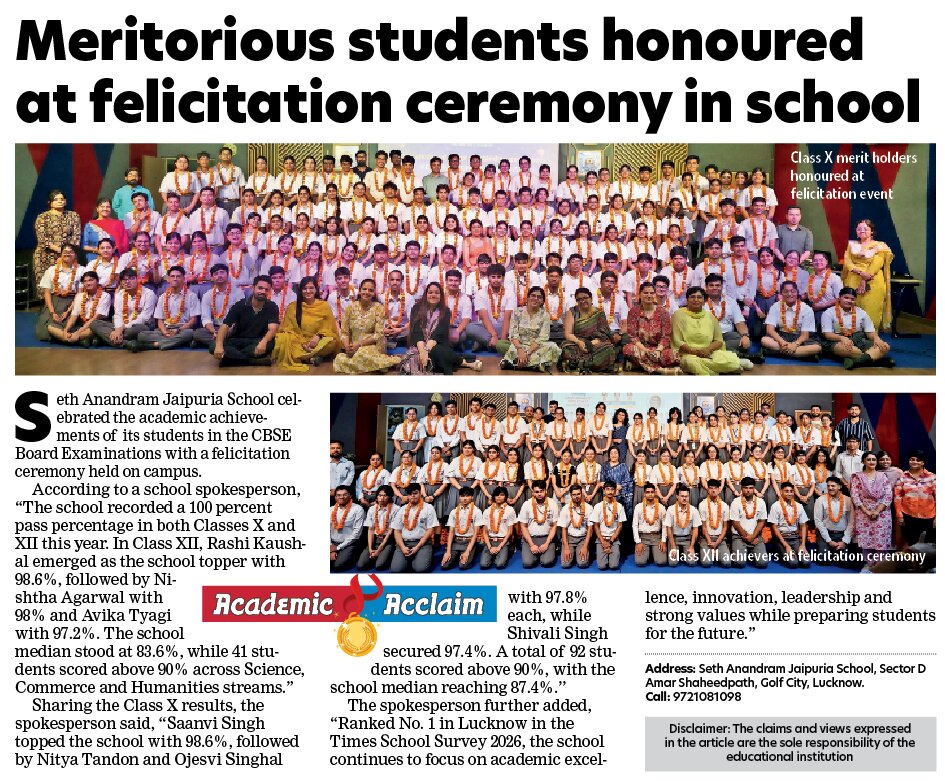
Meritorious Students Honoured at Felicitation Ceremony in School







The story of India’s development has two narratives – one of inexorable urban growth driven by an empowered middle-class, and the other of a huge untapped rural potential in villages and small towns. Technology has contextualized this contrast in the shape of a digital divide – the tech haves and have-nots of modern day India versus a rising Bharat.
The urban-rural schism has a deep bearing on education. A survey conducted by National Statistics Office (NSO) brings to light some fissures of this digital learning divide. The findings reveal that only 26.4% males aged 15 to 24 years in rural India are digitally literate compared to their 44.2% counterparts in urban India. The gap is still starker among rural females, with only 14.3% of them possessing basic digital literacy skills. In general, the internet skills of population in states such as Goa, Kerala and Tamil Nadu are much higher than those observed in Uttar Pradesh and Chhattisgarh.
At the core of this divide are infrastructural gaps. Schools in rural India still grapple with erratic power supply and lack of high speed internet. A study conducted by Azim Premji foundation revealed that about 60% of school children in rural areas lack access to online learning due to unavailability of devices or poor broadband connectivity. More often than not, teachers too don’t possess the digital skills nor the inclination to be tech-savvy. Communities strive on the fringes of digital inclusion. The rural India is yet to tune in to the global AI revolution leaving its footprint in the nation’s metropolises and IT capitals. In such a scenario, bridging this gap becomes a national priority, so that rural Bharat can power the nation’s growth in step with the urban India.
 Broadband Inclusivity: Transformation always begins at the grassroots level, but the vision must come from the top. India, under the leadership of Prime Minister Narendra Modi, has made notable strides towards inclusive digital revolution. The National Broadband Mission – launched earlier this year – aims to connect 2.7 lakh villages with optical fibre cable by 2030. The mission targets broadband connectivity to 90% of anchor institutions, including schools, in next five years. This bodes well for a nation where a major chunk of population still lives in villages.
Bridging the Language Divide: To bring rural Bharat up to speed with the urban India, the language gap must be bridged. Many a talent fail to avail opportunities and platforms to bloom due to the linguistic hurdle. The government has already taken the lead through platforms like DIKSHA which provides educational content in 36 Indian languages. Language barriers are also transcended through Bhashini, an AI powered real-time language translation platform. Government and private schools must leverage these platforms to facilitate digital inclusivity.
Professional Development of Teachers: The quality of education, it is often said, is as good as the quality of teachers. The National Education Policy 2020 mandates 50 hours of continuous professional development for teachers. A good part of this must be focused on digital upskilling, and AI training. Private teacher training academies such as Saamarthya Teachers Training Academy of Research (STTAR) have taken initiatives to provide ICT training to 10,000 teachers of government schools in Uttar Pradesh. More such progressive initiatives should be in order.
Community Empowerment: For the digital learning divide to be bridged, transformation must take place beyond classrooms and schools. Communities need to be made aware of the importance of tech savviness in a digital age. The recent decision of the UP government to allocate Rs. 278 crore to digitally empower gram panchayats is a step in the right direction and should be emulated in other states.
Public-Private Partnerships: Public policy push and private sector innovation should come together as force multipliers for a digital renaissance of rural India. The expertise of EdTech firms needs to be leveraged through PPP model for the larger public good.
Mahatma Gandhi had once said that India lives in its villages. The fact hasn’t changed over the last 8 decades. Today, about two-third of the 1.4 billion population lives in rural heartland, majority of them falling in the young age bracket. Tapping into the potential of this cohort through quality education, including digital learning and digital skills, will elevate the human capital exponentially. It will catalyze the country’s march towards a future where a digitally inclusive Bharat and modern India would converge to create a knowledge superpower, a developed nation and a beacon for the world to emulate.
ONLINE COVERAGE