Schools Welcome ‘Bharat’ in Textbooks, Await NCERT Directives
In a move that has sparked nationwide discussion and debate, media reports suggest that a committee constituted by the National Council of Educational Research and Training (NCERT) in India has proposed the replacement of the term ‘India’ with ‘Bharat’ in school textbooks. While NCERT has maintained that it is premature to comment on the issue, schools across the country are already embracing this development with open arms.
Schools see this shift, if adopted, as an opportunity to provide a more comprehensive understanding of the nation’s history, culture, and linguistic diversity. By using the term ‘Bharat,’ educators aim to foster a deeper connection between students and their heritage. This change is not just about semantics; it represents a significant shift in the way Indian students will perceive their country, school administrators say.
“Education is not just about imparting knowledge; it’s also about instilling values and a deep love for one’s country. This textbook alteration will serve as a stepping stone towards nurturing patriotism and preserving our unique heritage,” Alka Kapur, Principal of Modern Public School, Shalimar Bagh told Moneycontrol.
While some may argue that ‘India’ is more internationally recognised and has historical significance, proponents of ‘Bharat’ believe that it’s essential to have a broader perspective. By using ‘Bharat’ in textbooks, schools aim to instil a sense of pride in the rich tapestry of India’s cultural history, languages, and traditions.
Though the formal recognition of the move is awaited, educationists are already mulling what the execution would look like.
Rohan Parikh, Chairperson of The Green Acres Academy suggested textbooks should incorporate both ‘India’ and ‘Bharat’ when referring to the country. “It is a practice similar to that in various nations like Japan (Nippon), Korea (Hanguk) and Russia (Rossiya), which use different names externally and internally. This approach aims to provide a comprehensive understanding of our nation’s nomenclature,” Parikh said.
However, he said providing educational context and teacher training is crucial to help students understand the historical, cultural, and constitutional aspects of this change, similar to how other nations introduce students to different names for their countries.
In 2019, the country formerly known as the Former Yugoslav Republic of Macedonia officially changed its name to the Republic of North Macedonia. Besides, in 2018, the Kingdom of Swaziland announced that it would change its official name to the Kingdom of Eswatini.
For some, it is not a matter of changing India to Bharat in school textbooks alone. The implications will be much greater and changes will have to be initiated at many levels.
“Starting with The Constitution of India and the Preamble, which is there at the start of every NCERT textbook. I’m reminded of Shakespeare’s famous words: What’s in a name? That which we call a rose by any other name would smell just as sweet,” said Poonam Kochitty, Principal of Seth Anandram Jaipuria School, Lucknow, adding that, “Bharat will be just as dear a motherland as India is.”
“Stop complaining and start appreciating the opportunities life brings”
From 30th September 2023 to 7th October 2023, 60 students of our school, Seth AnandramJaipuria, Lucknow ranging from classes 6-12 visited NJP, Gangtok, Darjeeling, Mirik and Nepal Borders as a recreational trip after our half yearly exams. It was not only for fun but we also learnt quite a few facts about the places and the weather and, how due to the global warming for the first time it rained oh so heavily in the month of October. All due to our actions.
This trip was heaps of fun for me but a visit to a very special place in Darjeeling turned out to be an eye-opener for me. The people, the place, the work, the energy of The Tibetan Refugee Camp in Darjeeling touched every part of my heart and travelled to the deepest parts of my soul. People of this place made threads from fur, thread to carpets in an unimaginable speed like machines or even faster. When we entered the camp we were hit by a different vibe of positivity and warmth. People in 20s to people in 80s worked together happily in harmony, people listening to music, sitting working their hands, all smiles. When we asked them questions, they were the sweetest and answered everything enthusiastically. We met an 87 year old man who was so eager to talk to us and wove the local dresses with love. They were eager to know where we came from, how old we were and when asked to smile to get a photo their smiles were the prettiest ones.
Their hard work and dedication from morning to evening coming to the same place, doing the same work daily without leave yet with their heart filled with passion, no regrets, no complaints, just with happy hearts. Their work and their behaviour and mind-set towards life changed my mind-set, my thinking. It immediately made me think that we got a room just an inch small, food a tiny bit out of our taste and we were all full of complaints despite having things others can’t even imagine to have. If we all become that passionate about our work and give up complaining that we do about everything, just imagine how much more pleasing and carefree our life would become, we will become more efficient. So why don’t we just stop complaining about every mini little thing that we don’t like. The world will become a better place to be in.
I just hope this visit affected people as much as it affected me because changing this mind-set of complains and grudges that we hold will improve our lives truly. We will undoubtedly become more joyful like those people were at their work.
Written By – Nandini JainClass – XIA
Journey of Adventure and Discovery to GANGTOK & DARJEELING
Embarking on my first-ever school trip filled me with a mixture of excitement and nerves. It was an unforgettable journeyto GANGTOK and DARJEELING.
Day 1: We left school at 3:30 pm and reached the station by 4:30 pm. The excitement was palpable as we boarded the train at 7:10 pm after a satisfying lunch.
Day 2: Our day began with a breath-taking sunrise and a delicious breakfast. We spent our time playing games and prepared to reach NJP, packing our belongings. We arrived at NJP by 12:30 pm, had lunch, and then continued our journey toGANGTOK, reaching our hotel at 9:30 pm.
Day 3: The day blessed us with beautiful weather as we enjoyed a scrumptious breakfast before heading to BABA MANDIR, CHANGU SHIV MANDIR, and SHONGO LAKE, surrounded by clouds and chilly weather. We returned to our hotel at 7 pm, exhausted but fulfilled.
Day 4: After breakfast, we explored Gangtok with visits to ENCHEY MONASTERY, GUNGAN MONASTERY, TASHI VIEW POINT, and VALLEY VIEW POINT. After lunch, we departed for DARJEELING the Queen of WEST BENGAL, where we witnessed a mesmerizing sunset amidst smoky clouds. We reached R.J RESORT at 9 pm, enjoyed dinner, and retired to our rooms.
Day 5: Our itinerary faced delays due to heavy rainfall, but we jaipurians made the most of it with a fascinating session on “Why is it raining even after monsoons” and an enjoyable DJ Dance. In the evening, we braved the gentle drizzle for some local shopping on Mall Road, Darjeeling, followed by a Chinese dinner.
Day 6: After breakfast, we explored Darjeeling, visiting a REFUGEE CAMP, experiencing a TEA GARDEN, conquering TENZING ROCK, and indulging in shopping. After lunch, we departed for Mirik and Nepal, reaching Nepal at 6 pm, where we visited the PASHUPATINATH TEMPLE and did some shopping.
Day 7: We boarded a bus for NJP at 7:30 am, arriving on time at 10:30 am. While waiting for our train, we enjoyed playing games and had lunch in the waiting room. At 3:30 pm, we boarded the train and soon found ourselves engrossed in games and, before we knew it, it was time for dinner and sleep.
Day 8: We returned to our beloved Lucknow at 10:30 am, reached school by 11 am, and thenheaded home.
In all the trip was adventurous and fun of fun. It does have its challenges, but the joy, learning, and adventure overshadowed them. As we were back we were eager to share our experiences with family and friends. Special thanks to our principal, teachers, and tour guides for making this trip an unforgettable success with an incredible adventure filled with learning and endless fun.
Written By:- Vaishnavi Mishra
How are educational institutions adapting to sustainability and AI?
Educational institutions are increasingly taking steps to promote sustainability as a fundamental part of their educational mission. In addition to integrating the knowledge of the 17 Sustainable Development Goals (SDGs) into their curricula, schools are actively involving all stakeholders in their commitment to sustainability.
Faculty members are working closely with students to still sustainability into everyday classroom practices. These efforts encompass a wide range of activities, from conserving energy by turning off lights and computers when not in use, to maximise the use of paper and materials, practising recycling within the classroom, and encouraging waste-free lunches.
Green teams have emerged within these institutions, dedicated to promoting recycling and reuse, often turning discarded materials into creative projects. They also organise tree-planting drives and vermicomposting, employ sustainable IT practices, and minimise resource wastage during school events. These eco-warriors are playing a crucial role in making sustainable practices a habit within the educational environment.
STARTING SUSTAINABILITY FROM THE EARLY YEARS Recognising the impressionable nature of young learners, experts advocate for the incorporation of sustainability education from an early age. Simple activities such as planting saplings, tending to gardens, reusing materials, and even starting a worm farm can help children understand the profound connection between humans and nature.
IMPACT OF AI DEVICES ON EDUCATION “The rise of AI devices, including ChatGPT, has generated significant interest and debate in recent months. While these innovations offer users well-researched and human-like responses to text-based queries, there are concerns about their impact on the educational landscape,” said Dr Neeta Bali, Director of Schools, Seth Anandram Jaipuria Group of Schools.
Proponents argue that AI tools like ChatGPT can streamline the research process for teachers, allowing them more time for personalised teaching and addressing individual student needs.
However, there are worries that overreliance on such devices could lead to a decline in essential research skills, critical thinking, and originality. It is important to note that AI tools may not consistently provide authentic information, raising questions about their role in education.
[/vc_column_text][vc_column_text]Published by:- India Today Published on:- 08th Oct 2023 Link:- https://www.indiatoday.in/education-today/featurephilia/story/how-are-educational-institutions-adapting-to-sustainability-and-ai-2446080-2023-10-08
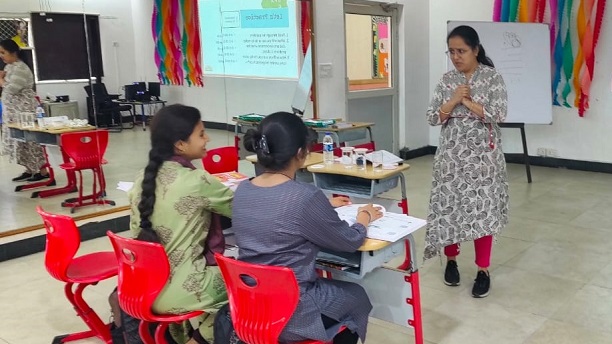
“Mastering the Art of Effective Communication” conducted by Mr Anubhav Singh at Seth Anandram Jaipuria School, Lucknow September 23, 2023
Key Topics Covered
1. Importance of Effective Communication: Mr. Anubhav emphasized the pivotal role that effective communication plays in various aspects of personal and professional life. He highlighted how it fosters understanding, builds relationships, and drives success in both individual and organizational contexts.
2. The Power of Communication: Mr. Anubhav delved into the transformative power of communication, showcasing how it can influence opinions, inspire action, and bring about positive change. He shared anecdotes and examples to illustrate the impact of effective communication in real-world scenarios.
3. The Seven Deadly Sins of Communication: During the session, Mr. Anubhav outlined seven common pitfalls that individuals should avoid when communicating. These included factors such as ambiguity, inconsistency, and neglecting feedback. He provided practical tips on how to recognize and rectify these habits to enhance communication effectiveness.
4. Seven C’s of Communication: Mr. Anubhav introduced the audience to the “Seven C’s” framework, which encompasses clarity, courteousness, concreteness, correctness, coherence, conciseness, and completeness. He elucidated how applying these principles can significantly enhance the clarity and impact of one’s message.
5. Avoiding Miscommunication: The speaker discussed the various factors that contribute to miscommunication, such as assumptions, lack of active listening, and cultural differences. He offered strategies to mitigate these risks, emphasizing the importance of active engagement and seeking clarifications when needed.
6. Voice Modulation Techniques: Mr. Anubhav shared valuable insights into the art of voice modulation, illustrating how it can be a powerful tool for engaging and captivating an audience. He provided practical exercises and tips on how to effectively use tone, pitch, and pace to convey messages with impact.
Conclusion and Takeaways
The session by Mr. Anubhav Singh proved to be highly beneficial and enriching for the attendees. His comprehensive coverage of key communication concepts, along with practical techniques, provided valuable tools for enhancing communication skills. Overall, the session was a resounding success, leaving a lasting impression on all participants. Mr. Anubhav’s expertise and engaging presentation style contributed to the session’s effectiveness and positive impact.
Discover Excellence at Seth Anandram Jaipuria School: Among the Best School in Lucknow
Looking for the top schools in Lucknow? Your search ends here! Seth Anandram Jaipuria School proudly stands as one of the best educational institutions in the city, fostering holistic development and academic brilliance.
Nurturing Brilliance: Our school boasts a legacy of excellence, offering a comprehensive learning experience that goes beyond textbooks. With a dynamic curriculum and dedicated educators, we empower students to shine in all facets of life.
Green Learning: We take pride in our commitment to sustainability. As one of the leading eco-conscious schools, we’ve inaugurated a vibrant terrace garden, enhancing practical learning through organic cultivation of fruits, vegetables, and medicinal herbs.
Academics with Impact: Ranked among the top schools in Lucknow, we combine traditional values with modern teaching methodologies. Our students not only excel academically but also develop critical thinking, creativity, and leadership skills.
Strong Foundation: At Seth Anandram Jaipuria School, we believe in forging strong bonds within our school community. Our Principal, Ms. Poonam Kochitty, and Vice Principal, Ms. Monika Taneja, personally inaugurated the terrace garden, underlining our commitment to hands-on learning and environmental awareness.
Achievements Beyond Boundaries: We pride ourselves on producing well-rounded individuals who excel not only in academics but also in extracurricular pursuits. Our students have consistently achieved excellence at state and national levels.
Discover the difference at Seth Anandram Jaipuria School, one of the top schools in Lucknow. Join us in nurturing brilliance, fostering sustainable practices, and creating leaders of tomorrow.
Lessons in the Dark
On 2nd August 2023, my school Seth Anand Ram Jaipuria organized ‘Lessons in the Dark’ and we had a constructive discussion on LGBTQIA+ by Ms. Suparna.
Hosting a LGBTQIA+ workshop in school creates a space for students to learn and open up about different experiences, perspectives, and identities. Having these discussions in a school setting help build a more inclusive and welcoming atmosphere for all students, regardless of their sexuality, gender, or any other factors.
I’m privileged that I was able to participate in the LGBTQIA+ workshop in my school. It was great to hear from students with different points of view and experiences. Teachers as well as students democratically and respectfully shared their views and opinions on the topic. One great thing about SAJS, Lucknow is that no one forces their opinions on anyone. Such a taboo topic and a difficult conversation was done with such simplicity and ease. Before coming to SAJS I had never witnessed an open student-teacher interaction on such forbidden topics.
I love how teachers allow and encourage students to voice contradicting opinions and voice their thoughts regardless the authority of the person they are willing to speak against. Whenever I share my school of thought I feel free, respected, and heard. This shows that our school has a growth mindset and believes in fostering the same in us – the Gen Z and Gen Alpha. During the session we learned various aspects of LGBTQIA+ along with the types.
It stirred a healthy debate amongst students outside the workshop, compelling them to ask difficult questions. I witnessed discussions and debates all over the building, in classrooms, corridors and even on the staircase. I believe the event was successful as it has stimulated and facilitated critical thinking in the students. It has sowed the seed for a tree that has yet to reach the sky.
Written by – Vedankita Gupta (XI A)
PGI- D Assessing The Indian Education Status At District Level
School Education is considered the foundation of the whole career, it must be strong and the best in every aspect. The government in India has been trying to make improvements in school education through various schemes over the years. Performance Grading Index is one assessment report that is a relatively new index that measures the performance of states in school education. PGI-D aims to measure the performance of schools in every district over the policies rolled out by states and central government. PGI-D works as a performance review of the education industry’s ongoing education pattern and overall outcome.
According to the PGI-D, with about 14.9 lakh schools, 95 lakh teachers, and nearly 26.5 crore students from varied socio-economic backgrounds the Indian education sector is vast and also consists of a huge network. As India contains a large population of youth, the index is significant in order to rejuvenate the education quality in the country right from the district level.
PGI-D assess the performance of schools based on 6 categories viz., Outcomes, Effective Classroom Transaction, Infrastructure Facilities & Student Entitlements, School Safety & Child Protection, Digital Learning and Governance Process. These categories are further divided into 12 domains, viz., Learning Outcomes and Quality (LO), Access Outcomes (AO), Teacher Availability and Professional Development Outcomes (TAPDO), Learning Management (LM), Learning Enrichment Activities (LEA), Infrastructure, Facilities, Student Entitlements (IF&SE), School Safety and Child Protection (SS&CP), Digital Learning (DL), Funds convergence and utilization (FCV), Enhancing CRCs Performance (CRCP), Attendance Monitoring Systems (AMS) and School Leadership Development (SLD).
Commenting on the insights given by PGI-D, Ajay Gupta Founder of Bachpan Play Schools and Academic Heights Public Schools, said, “PGI-D (Performance Grading Index for Districts) Report is a great initiative on the part of our government. This will help to assess student performance and learning outcomes on a deeper level. Identifying gaps at this level is going to facilitate much-needed reforms in our country’s education system and set the path for the future.”
The most applauded thing about the index is that this highlights the loopholes and shortcomings of district-level education and urging the authorities to work more effectively. Talking about its critical side, Raju Varghese, Director, IQAC & Global programs, Lexicon Management Institute of Leadership and Excellence said, “PGI-D works well. However, the number of districts participating needs to increase in number. An attempt must be made by districts to clock the ‘Daksh’ grade as none of the districts has got the highest grade, so far. The index is primary in nature as it is a first step to measure districts across specific parameters.”
He further added that the school education system becomes dynamic by moving from the docile and rote phase to the dynamic phase. Creativity in learning systems is explored further. The emphasis on alternatives to teaching pedagogies is better explored.
Sharing thoughts over the PGI-D report, Poonam Kochitty, Principal, Seth Anandram Jaipuria School, said, “The PGI-D assesses the performance of the school education system at the district level with an index-based system. It is grouped under 6 categories, Outcomes, Effective Classroom Transaction, Infrastructure Facilities & Student Entitlements, School Safety & Child Protection, Digital Learning and Governance Process. The findings indicate that none of the 748 districts secured the top two grades – Daksh and Utkarsh. Most districts were in the bottom three grades (less than 10 per cent to 30 per cent ).
In the digital learning (DL) domain, in 2021-22 majority of the districts were in the bottom 3 grades which shows the poorest performance in this parameter as compared to the others.
Students are the bricks over whole nation build up and education is the element that turns them into capital for their respective countries, hence the assessment index like PGI-D works as a critical as well as prominent way to know the on-ground situation of ongoing education pedagogy in India and offer proper space to make a quick fix to it.
An Outstanding Poet in the Making – Ira Dwivedi of Seth Anandram Jaipuria School
Embracing the Lessons of Darkness: The Silent Siren
“Darkness is a great teacher, reminding us to rise like a Phoenix from the ashes of the past.”
These words have resonated deeply within me, inspiring me to embark on a poetic journey and share my collection of verses with the world. In a society where panic and insecurity often consume us in the face of negative situations or failures, it is crucial to remember the transformative power hidden within those moments of darkness.
The Silent Siren, my newly published book, is a testament to this philosophy. It is a collection of poems that aim to remind readers of the hidden opportunities and untapped potential that lie within the depths of despair. Through the rhythmic flow of words, I seek to guide them towards a path of self-discovery and resilience.
Writing has always been my passion, serving as a vessel through which I can express my deepest thoughts, ideas, and emotions. It is through writing that I discovered my ability to unravel the complexities of everyday life problems, presenting them in a poetic and philosophical manner. The simplicity of daily challenges, when seen through the lens of introspection, often reveals profound truths and insights waiting to be discovered.
My aspiration as a writer is to adopt a philosophical yet rational mindset, creating a space where the complexities of life can be explored and contemplated. The Silent Siren serves as a gateway to this realm, inviting readers to delve into their own introspection and question the significance of their experiences.The poems within this collection offer solace and guidance to those who find themselves lost in the labyrinth of life. They serve as gentle reminders that failure and darkness are not to be feared, but rather embraced as catalysts for growth. Each verse presents an opportunity to rise again, much like the mythical Phoenix that emerges triumphantly from the ashes of its past.
Ira Dwivedi IX E
CBSE Schools Registering with EPFO to Benefit Teachers, Staff
In a recent directive announced by the Employee Provident Fund Organisation (EPFO), a statutory body under the Ministry of Labour and Employment, all CBSE-affiliated schools are mandatorily required to register themselves with EPFO. The new norm is said to provide EPF benefits to employees or teachers working at small or mid-level schools located in rural areas and functional for three years or more, even without a minimum of 20 employees.
The new mandate for EPF registration is also aimed at improving compliance among establishments, including schools. “By registering with EPFO, schools can ensure that their employees receive retirement benefits like provident fund, pension, and insurance. Now as a legal obligation, social and financial security through retirement benefits will be extended to them. This step can help attract and retain talented employees,” says Bikram Agarwal, chief financial officer (CFO), Seth Anandram Jaipuria Group of Educational Institutions, Uttar Pradesh.
Now, even private schools are required to contribute 12% of the employee’s basic salary plus dearness allowance towards the employee’s EPF account, while the employee contributes an equal amount. In addition, employers are required to contribute 0.5% of the employee’s basic salary towards the Employees’ Deposit Linked Insurance (EDLI) scheme, which provides life insurance cover to the employee.
It is important to note that the benefits of PF amount may vary depending on the specific nature of the job and recruitment type. Explaining the benefits, Agarwal says, “School teachers hired on a contractual basis, for them the benefits of PF may be limited to the duration of the contract. However, in the long term, PF registration will prove to be mutually beneficial for both teachers and the school fraternity. Schools can attract and retain talented teachers. Also, teachers are more likely to stay with a school that offers them financial security and stability during post-retirement years as they will be provided a corpus of savings to manage their financial needs. This will bring job satisfaction among teachers and in the long term will also improve the overall academic health of schools.”
The new mandate also aims to improve the compliance of school authorities with PF regulations and penalise the defaulter for non-compliance. Thus, teachers and school staff can reach out to the relevant government authorities such as the Ministry of Labour and Employment or the EPFO office, if a CBSE school is not following the labour laws regarding PF contributions or any other employee benefit.
Most CBSE schools contribute to their employees’ accounts. By making school registration with EPFO mandatory, compliance awareness among schools from tier II, and III cities will grow, leading to accountability on their part.
Sharing the benefits, Bharathi Lakshmi, principal, Hindustan International School, Chennai, says, “The main problem with the process followed for the PF deduction and amount disbursal was that it was not prescribed as a legal mandate for management committees of all schools. So, teachers switching jobs faced issues getting their PF account details from their previous school employer. It used to hamper the practice of continuing the existing account for further acceptance of PF deductions.” This scenario is set to improve as school management will stay away from non-compliance and teachers can also bring the loopholes to the forefront. “As a principal, I am the coordinating factor between teachers and school management. Taking care of my duty, I am now obligated to make the process smoother and faster for teachers and even non-academic staff also. I have to ensure that full-time teachers and admission counsellors, administration staff, and lab helpers are provided the financial security net as applicable and the related communication is provided to them through monthly SMS and email services,” adds Lakshmi.